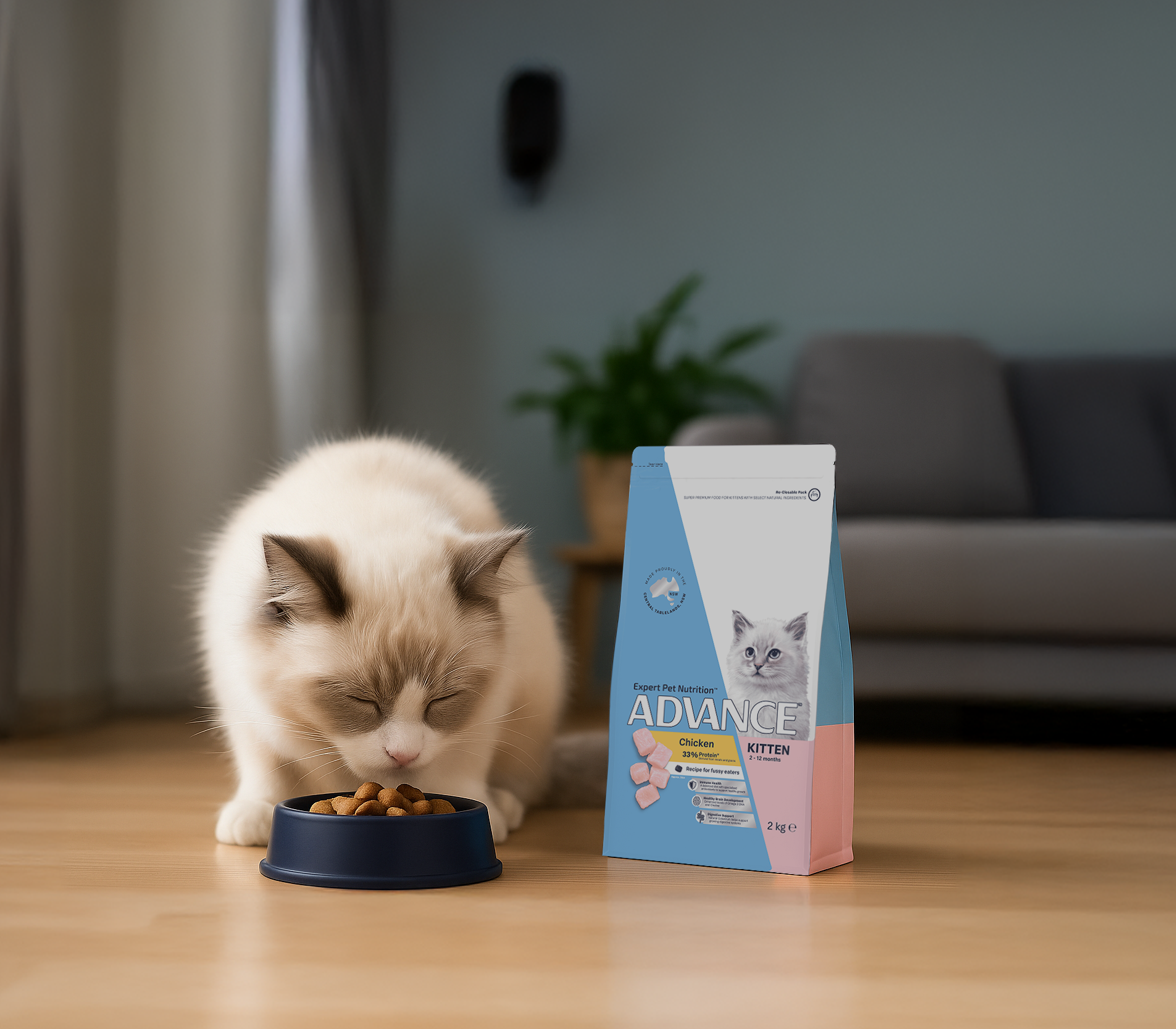
The Detail Most Cat Food Guides Leave Out
Did you know that your cat's indoor or outdoor lifestyle changes how much dry food they need? Sometimes by as much as one full cup per week. And yet most feeding guides present a single number and leave the rest to guesswork.
The ADVANCE™ dry cat food feeding guide does something more useful. It gives adult cats two separate charts — one for active cats and one for inactive cats — because the difference is real, it's meaningful, and it directly affects whether your cat maintains a healthy weight over time.
This guide covers both of those charts in full, plus the complete kitten dry food feeding guide by age, so whether you're caring for a new kitten or a settled adult, you'll leave with a number you can actually use.
Why Dry Food? What Kibble Contributes to Your Cat's Health
Dry cat food earns its place in the bowl for reasons that go beyond convenience. The mechanical action of chewing kibble helps reduce plaque and tartar build-up on your cat's teeth — a genuine, low-effort contribution to oral health that wet food alone can't replicate. Dry food is also calorie-dense and nutrient-concentrated, which means accurate measurement matters — small variations in portion size have a larger proportional impact than they would with wet food.
For kittens especially, introducing dry food during the early growth phase helps build positive eating habits and supports dental development. Most Australian vets recommend a mixed diet — some wet food for hydration, some dry food for texture variety and dental benefit — as the ideal approach across all life stages.
ADVANCE™ dry cat food is formulated to be complete and balanced, backed by the Waltham Petcare Science Institute research. Every cup is designed to deliver the full nutritional profile your cat needs — all that's required is knowing how many cups that actually is.
Part 1: Kitten Dry Food Feeding Guide (From 8 Weeks to 40 Weeks)
Kittens have energy needs that can be two to three times higher per kilogram than an adult cat's. This reflects the enormous metabolic effort of building a body from the ground up: bones, muscles, organs, teeth, immune system, and brain, all developing simultaneously across the first 10 months of life.
The ADVANCE™ kitten dry food feeding chart below is measured in standard metric cups per day and covers the full growth window from 8 weeks to 40 weeks.
ADVANCE™ Kitten Dry Food Feeding Chart
| Age of Kitten | Cups per day |
| 8 weeks | 1⁄3 cup |
| 12 weeks | 1⁄2 cup |
| 16 weeks | 1⁄2 cup |
| 24 weeks | 1⁄2 cup |
| 32 weeks | 2⁄3 cup |
| 40 weeks | 2⁄3 cup |
All measurements use a standard Australian metric cup (250 ml). For ADVANCE™ dry cat food, 1 cup = 115 grams.
Mixing dry and wet kitten food? Halve the recommended daily amounts of both products. So if your kitten's dry guide says ½ cup per day, serve ¼ cup of dry food plus the corresponding half-portion of ADVANCE™ wet kitten food.
Reading the Kitten Chart: What the Numbers Tell You
The gradual increase from ⅓ cup at 8 weeks to ⅔ cup at 32–40 weeks tracks the arc of kitten development closely. At 8 weeks, a kitten has just been weaned — their digestive system is still adapting to solid food, and smaller portions more frequently is the right approach.
The step up that happens between 24 and 32 weeks reflects a meaningful shift in growth priorities. In early kittenhood, energy goes toward organ development and immune system maturation. From around 6 months onwards, the focus shifts to musculoskeletal development — kittens are growing into their adult form, and their dry food intake rises to match. The amount plateaus at ⅔ cup from 32 weeks, where it holds until the transition to adult food.
Kittens should gain weight gradually — approximately 100 grams per week up until around 5 months of age. If your kitten seems to be gaining too fast or too slowly, it's worth checking in with your vet before adjusting portions significantly.
How Often to Feed Your Kitten Dry Food Per Day
Kittens stomachs are small, relative to their energy needs, and regular meals keep blood sugar stable and energy consistent — particularly important for small breeds where hypoglycaemia is a real risk if meals are skipped.
8 weeks to 3 months: 3–4 meals per day, evenly spaced through waking hours.
3 to 6 months: 3 meals per day. Growth is rapid and consistent fuel throughout the day supports it.
6 months onwards: 2 meals per day — typically morning and evening. Most kittens transition comfortably to this rhythm and maintain it into adulthood.
Predictable feeding also builds healthy digestive rhythms, reduces food anxiety, and makes it significantly easier to notice when appetite drops — which can be an early indicator of health issues. Cats, even young ones, genuinely thrive on routine.
Part 2: Adult Cat Dry Food Feeding Guide
Once a cat reaches adulthood — typically between 9 and 12 months for most breeds — their nutritional requirements shift from growth-focused to maintenance-focused. Adult dry feeding guides are structured by current body weight, because that's the primary driver of a healthy adult cat's daily calorie needs.
But ADVANCE™ goes one important step further. The adult dry food guide accounts for something most pet food brands leave to guesswork: whether your cat is active or inactive. This is the distinction that makes all the difference.
ADVANCE™ Adult Dry Cat Food: Active Cats
| Weight of Cat | Cups per day |
| 3 kg | 1⁄3 cup |
| 4 kg | 1⁄2 cup |
| 5 kg | 1⁄2 cup |
| 6 kg | 2⁄3 cup |
| 7 kg | 2⁄3 cup |
ADVANCE™ Adult Dry Cat Food: Inactive
| Weight of Cat | Cups per day |
| 3 kg | 1⁄3 cup |
| 4 kg | 1⁄3 cup |
| 5 kg | 1⁄3 cup |
| 6 kg | 1⁄2 cup |
| 7 kg | 1⁄2 cup |
Mixing dry and wet adult food? Halve the recommended daily quantities of each. So if your 4 kg active cat's guide says 1⁄2 cup per day, serve 1⁄4 cup of dry food plus the corresponding half-portion of ADVANCE™ adult wet food.
Active vs. Inactive: Which Category Is Your Cat?
An active cat is one who spends meaningful time outdoors, engages in sustained play, has regular access to climbing and running, or is young and naturally energetic. Active cats burn more energy maintaining body temperature, navigating territory, and engaging in predatory play — and their dry food portions reflect that higher daily expenditure.
An inactive cat is more commonly an indoor-only cat, an older cat, a desexed cat who has settled into a calmer lifestyle, or any cat whose day mostly involves sleeping, eating, and watching the world from a window. Desexed cats in particular often see a meaningful reduction in metabolic rate after the procedure — and continuing to feed them as if they're still active can quietly contribute to weight gain over months and years.
When in doubt, lean toward the inactive chart and monitor body condition over 2–3 weeks. It's far easier to slightly increase portions once you've confirmed your cat needs more than it is to address weight gain that's already accumulated.
When Does Your Kitten Become an Adult? Timing the Switch
For most domestic cat breeds, the transition happens between 9 and 12 months. Larger breeds — such as Maine Coons, Norwegian Forest Cats, or Ragdolls — may not reach full physical maturity until 15–18 months and may benefit from staying on kitten formula slightly longer. If you're unsure, your vet is the best person to advise based on your individual cat's development.
When the time comes, transition gradually. Abrupt switches can cause digestive upset — cats have sensitive digestive systems and tend to need a little time to adjust to new foods, even high-quality ones.
Transitioning to ADVANCE™ Dry Cat Food: The 7-Day Rule
Aim for a 7-to-10-day window, increasing the proportion of ADVANCE™ dry food by roughly 25% every 2 days while decreasing the previous food in equal measure.
If your cat shows soft stools, reduced appetite, or any digestive sensitivity during the transition, slow down. Extend the process to 14 days. Some cats are far more sensitive to dietary change than others — patience during the transition pays off in a smoother adjustment and a cat who embraces the new food rather than resisting it.
5 Signs Your Cat's Dry Food Portions Are Right
Ribs you can feel but not see. Gentle pressure along your cat's sides should reveal the ribs without difficulty — but they shouldn't be visible from across the room. A thick layer of fat requiring firm pressure to feel through suggests overfeeding. Visible, prominent ribs suggest underfeeding.
A visible waist from above. Looking down at your cat, there should be a clear narrowing between the rib cage and the hips. No waist definition is one of the earliest visible signs of ongoing weight gain.
Appropriate energy for the time of day. A well-nourished cat is alert and interested in interaction, with natural activity patterns — bursts of play followed by rest. Persistent lethargy, or constant food-seeking behaviour between meals, can both signal that portions need revisiting.
A coat in good condition. ADVANCE™ dry cat food is formulated with essential fatty acids to support a healthy coat. Dullness or excessive shedding can signal nutritional imbalance.
Steady weight over time. For adult cats, body weight should be stable month to month. Gradual gain or loss without a clear cause is worth investigating — and starting with a portion review is the right first step.
Dry Food and Water: The One Rule That Doesn't Bend
Cats on a primarily dry food diet need reliable, unrestricted access to fresh water at all times. Unlike wet food, which contributes meaningfully to daily hydration through its moisture content, dry kibble provides very little water — and cats have a naturally low thirst drive that means they won't always drink enough to compensate.
Read more about how to get your cat to drink more water in our helpful guide.
Also Feeding Wet Food? Here's the Other Half of the Story
Dry food supports oral health, the satiety, and the convenience. Wet food handles the hydration — and for cats, that's not a small thing. A cat's daily water intake can triple when wet food is part of the routine. Discover the full picture in the ADVANCE™ Wet Cat Food Feeding Guide, with complete daily tray and pouch charts for kittens and adult cats, and everything you need to confidently balance a mixed diet.
Frequently Asked Questions
How many cups of dry cat food should I feed my cat per day?
For ADVANCE™ adult dry cat food, active cats need 1⁄3 to 2⁄3 of a cup per day depending on weight (3–7 kg). Inactive cats need slightly less — 1⁄3 to 1⁄2 cup over the same weight range. Kittens need ⅓ to ⅔ of a cup per day depending on age (8–40 weeks). All measurements use a standard Australian metric cup (250 ml).
How much dry food should I feed my kitten per day?
ADVANCE™ kitten dry food guide recommends ⅓ cup per day at 8 weeks, rising to 1⁄2 cup from 12–24 weeks, then 2⁄3 cup from 32 weeks to 40 weeks. Divide the daily amount into 3–4 smaller meals until 6 months of age, then 2 meals per day from 6 months onwards.
What's the difference between the active and inactive feeding guides for cats?
For a 4–5 kg cat, the difference is ⅙ of a cup per day — active cats get 1⁄2 cup, inactive cats get 1⁄3 cup. Inactive cats have lower daily energy expenditure and need fewer calories to maintain a healthy weight. Indoor-only and desexed cats typically fall into the inactive category.
Can I mix ADVANCE™ dry and wet cat food?
Yes — and a mixed diet is generally recommended. When mixing, halve the recommended daily quantities of both products. So if the guide says 1⁄2 cup of dry per day, serve 1⁄4 cup of dry food plus the half-portion equivalent of ADVANCE™ wet food.
When should I switch my kitten from kitten dry food to adult dry food?
Most cats are ready to transition between 9 and 12 months. Larger breeds may benefit from staying on kitten food until 15–18 months. Always transition gradually over 7–10 days to avoid digestive upset.
How often should I feed my adult cat dry food per day?
Adult cats do well on 2 meals per day — morning and evening. Do not leave large amounts of dry food out all day, as free-feeding makes it very difficult to monitor intake and can contribute to gradual weight gain.
Is dry food alone enough for my cat's complete nutrition?
ADVANCE™ dry cat food is formulated as a complete and balanced diet, providing all the nutrients your cat needs when fed in the right quantities. However, for cats with low water intake or a history of urinary issues, incorporating some wet food is often advisable. If you have concerns about your cat's specific health needs, speak with your vet.