Photo by Yuliia Martsynkevych on Unsplash
Feeding your kitten
Cats are classed as obligate carnivores and have unique nutritional requirements. Therefore, nutrition plays a critical role in ensuring healthy kitten growth and development. Let's consider some common feeding queries to help your kitten grow up right.
Whether you're bringing home a new kitten or simply want to make sure you're on the right track, understanding kitten feeding guidelines doesn't need to be complicated. The essentials come down to three things: how much to feed a kitten, how often to feed kittens, and what to feed a kitten at each stage of their growth. From the first weeks of weaning through to their first birthday, a kitten's nutritional needs shift dramatically — and getting it right sets the foundation for a long, healthy life.
In this guide, we'll walk you through everything you need to know about kitten nutrition and growth food, including feeding frequency by age, the key nutrients your kitten needs for healthy development, and how to choose between wet and dry food options. We'll also share practical kitten feeding guidelines you can follow with confidence — because when you know what to feed and how much, mealtime becomes one of the simplest ways to enrich their everyday.
Kitten Feeding at a Glance
- Start with the feeding guide on your kitten food packaging, then adjust based on body condition and growth rate.
- Younger kittens (8–12 weeks) need 4 meals daily; at 3–6 months, reduce to 3 meals; from 6–12 months, 2 meals per day is typical.
- Kittens should be fed a complete, balanced kitten growth food formulated for their life stage — with high-quality protein, essential fatty acids, calcium and phosphorus, vitamins, minerals, and DHA for brain and eye development.
- Both wet and dry food are equally nutritious. Dry food is convenient and supports dental health; wet food adds moisture and appeals to picky eaters. Mixed feeding is a popular option.
Kitten feeding guide by age
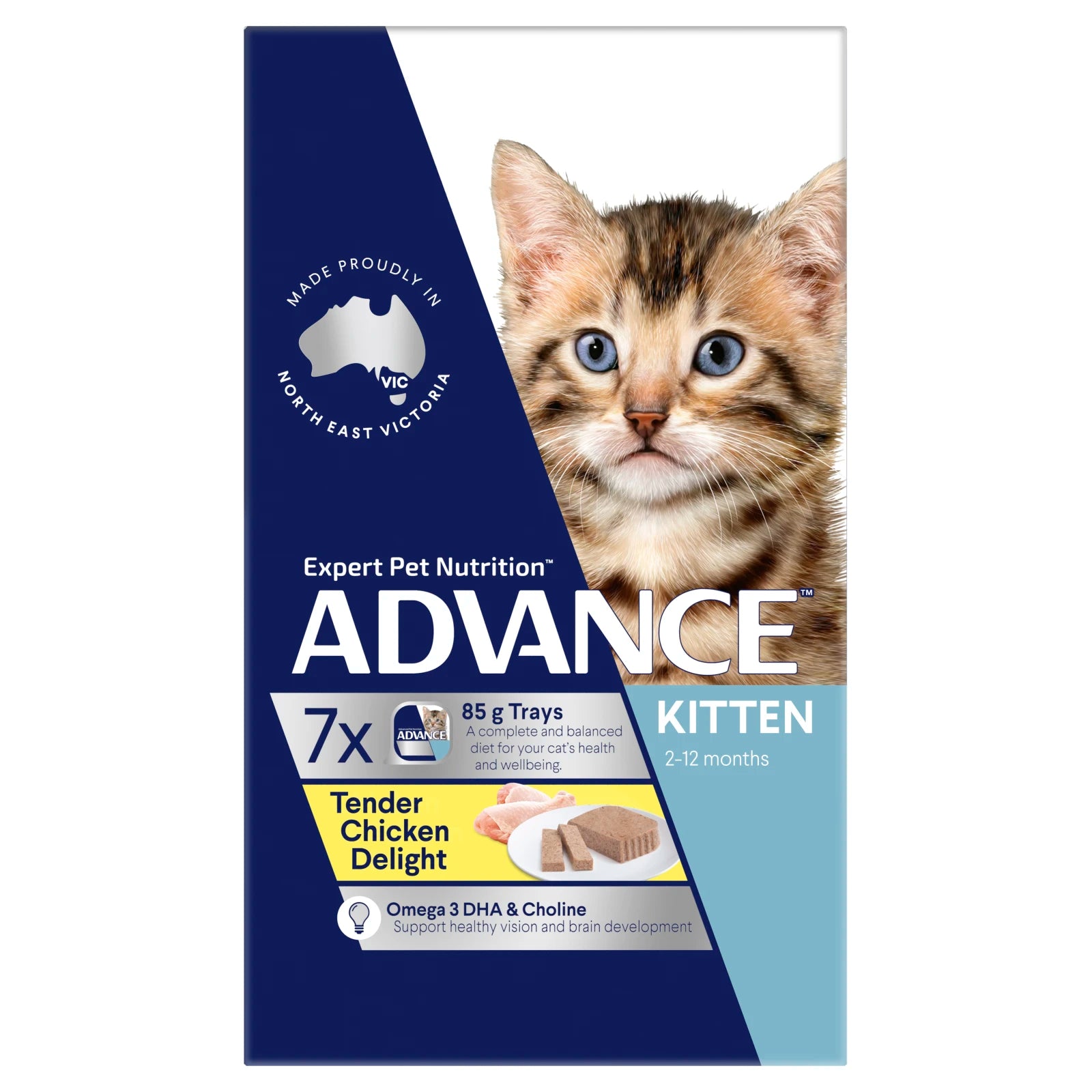
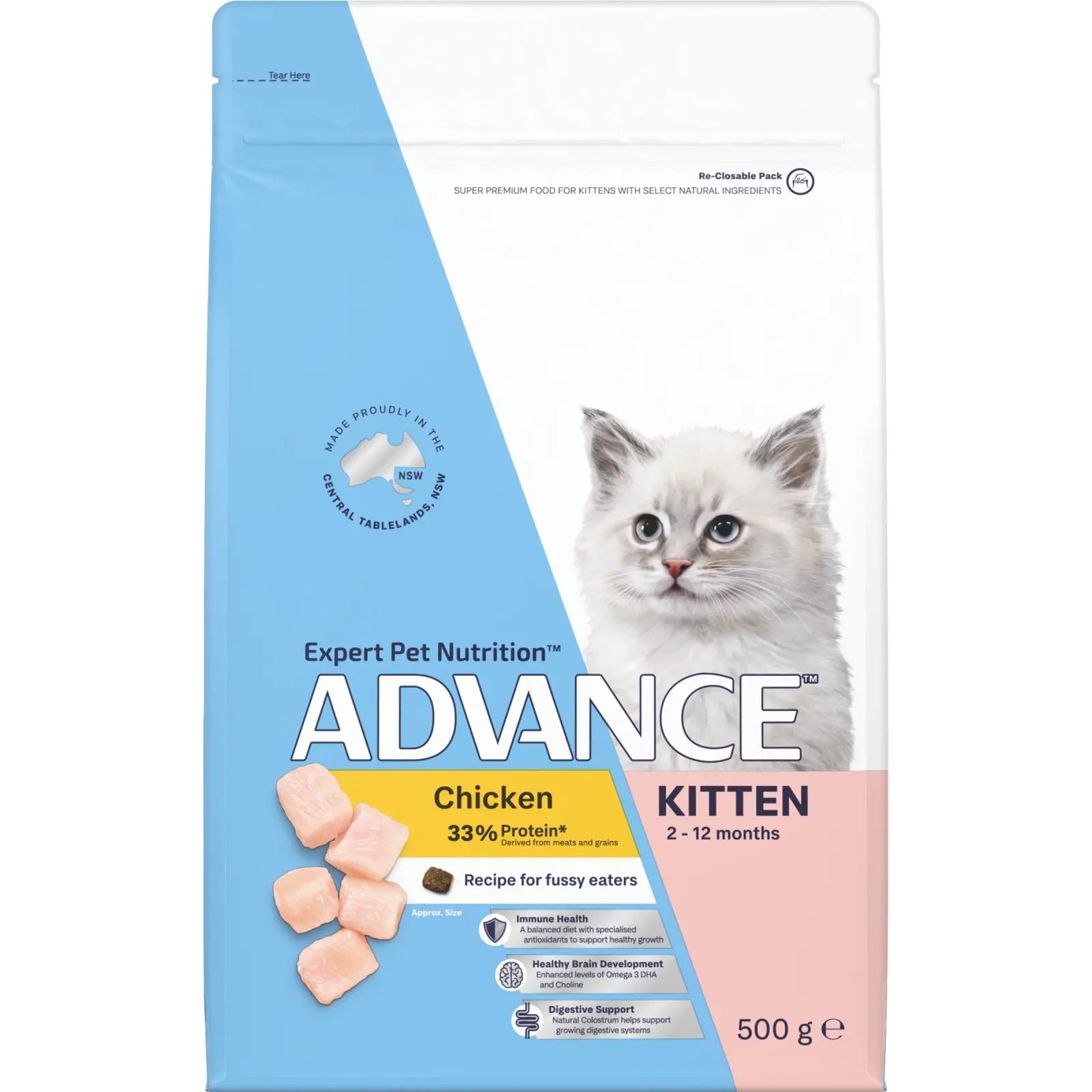
Every kitten grows at their own pace, but here's a general guide to how much to feed a kitten at each stage of development. Use this as a starting point alongside the feeding guide on your ADVANCE™ kitten food packaging, and adjust based on your kitten's body condition and activity level.
| Age | Food Type | Meals per Day | Approx. Daily Amount* | Key Focus |
| 4–8 weeks | Kitten milk replacer / softened kitten kibble | 4–6 (free-feed if possible) | As guided by vet or milk replacer instructions | Weaning & transition to solids |
| 8–12 weeks | Moistened or dry kitten kibble / wet kitten food | 4 | Follow packaging guide (approx. 50–65g dry or 2–3 pouches wet) | Establishing solid food routine |
| 3–6 months | Kitten dry and/or wet food | 3 | Follow packaging guide (approx. 65–80g dry or 3 pouches wet) | Supporting rapid growth & muscle development |
| 6–12 months | Kitten dry and/or wet food | 2 | Follow packaging guide (approx. 70–90g dry or 3–4 pouches wet) | Slowing growth, maintaining healthy weight |
| 12 months+ | ADVANCE™ adult cat food (dry and/or wet) | 2 | Transition to adult feeding guide | Adult maintenance & long-term health |
*Approximate amounts are general guides only. Always refer to the specific feeding guide on your ADVANCE™ product packaging and consult your veterinarian for tailored advice.
How often to feed kittens: a daily schedule
One of the most common questions new kitten owners ask is how often to feed kittens. The answer depends on their age — younger kittens have small stomachs and need frequent, small meals to fuel their rapid growth, while older kittens can manage larger portions less often. Here's a practical daily feeding schedule you can follow:
| Age | Meals per Day | Suggested Times | Portion Size |
| 4–8 weeks | 4–6 | 7am, 11am, 3pm, 7pm (or free-feed) | Very small — kitten-sized portions |
| 8–12 weeks | 4 | 7am, 12pm, 5pm, 8pm | Small — split daily guide into 4 |
| 3–6 months | 3 | 8am, 1pm, 6pm | Medium — split daily guide into 3 |
| 6–12 months | 2 | 8am, 6pm | Larger — split daily guide into 2 |
| 12 months+ | 2 | 8am, 6pm | Adult portions per packaging guide |
Tip: Cats are naturally graze feeders, and many regulate their food intake well. It's perfectly acceptable to measure out your kitten's daily food allowance and offer it across multiple meals or leave it available for grazing — just monitor their body condition on an ongoing basis to avoid overfeeding.
Food toys are another great option. From rolling toys that drop out a kibble intermittently to stationary puzzles that require your kitten to work for their food, these can provide both mental and physical stimulation at mealtime.
Kitten nutrition: what nutrients do kittens need?
Because cats are obligate carnivores, kitten nutrition looks quite different from human or even canine nutrition. Kittens need a precise balance of nutrients to support their rapid growth — in their first year, a kitten can grow from a tiny handful to nearly their full adult size.
That's why choosing a purpose-formulated kitten growth food is one of the most important decisions you'll make as a pet parent.
So, what nutrients do kittens need? Here are the key building blocks for healthy development:
- High-quality protein: The foundation of kitten nutrition. Protein supplies the amino acids needed for muscle growth, tissue repair, and a healthy immune system. Look for kitten food with animal-based protein as the primary ingredient.
- Essential fatty acids: Including omega-3 and omega-6, these support healthy skin, a glossy coat, and overall cellular function. They also play a role in reducing inflammation.
- Calcium and phosphorus: Essential for the development of strong bones and teeth. The right calcium-to-phosphorus ratio is critical — too much or too little of either can cause skeletal problems.
- Vitamins and minerals: A full spectrum of vitamins (A, D, E, B-complex) and minerals (iron, zinc, copper) supports immune function, energy metabolism, and overall vitality.
- DHA (docosahexaenoic acid): An omega-3 fatty acid that's particularly important for brain and vision development in young kittens. DHA is found naturally in fish oils.
- Taurine: An essential amino acid for cats. Unlike dogs and humans, cats cannot produce enough taurine on their own, so it must be supplied in their diet. It's vital for heart and eye health.
The simplest way to ensure your kitten gets all of these nutrients in the right balance is to feed a complete, balanced super-premium kitten growth food — like ADVANCE™ kitten formulas, which are scientifically formulated to support every stage of your kitten's development.
As your kitten grows, their nutritional needs change. In the early weeks, they rely on their mother's milk or a milk replacer. From around 4–8 weeks, they begin transitioning to energy-dense, protein-rich solid food to fuel their rapid growth. By 12 months, their growth slows and they're ready to transition to an adult formula — a gradual switch over 7–10 days helps avoid digestive upset.
Should I feed my kitten wet or dry food?
It's one of the most common questions we hear: should I feed my kitten wet or dry food? The good news is that both options are equally nutritious when you choose a complete, balanced kitten formula — so the answer comes down to what works best for your kitten and your lifestyle. Many pet parents choose a combination of both. Here's how they compare:
| Feature | Dry Food | Wet Food |
| Convenience | Easy to store, measure, and serve. Can be left out for grazing. | Needs refrigeration after opening. Best served fresh per meal. |
| Dental health | The crunchy texture helps reduce plaque and tartar buildup. | Less mechanical cleaning action on teeth. |
| Hydration | Low moisture content — ensure fresh water is always available. | High moisture content (approx. 70–80%) — great for supporting hydration. |
| Palatability | Generally well-accepted; some kittens prefer the crunch. | Higher aroma and softer texture — ideal for picky or fussy eaters. |
| Cost efficiency | Typically more cost-effective per meal. | Generally more expensive per meal. |
| Portion control | Easy to measure exact daily amounts. | Pre-portioned pouches/cans make serving simple. |
| Best for | Everyday feeding, grazing, dental support. | Adding moisture, encouraging appetite, variety. |
Mixed feeding — combining wet and dry food — is a popular choice that gives your kitten the best of both worlds. If you choose this approach, simply halve the recommended daily quantity of each product so your kitten gets the right total amount without overeating. For example, if the daily guide suggests 80g of dry food or 3 pouches of wet food, offer 40g of dry and 1.5 pouches of wet per day.
Whatever you choose, the key is consistency. Stick with a complete, balanced kitten formula and always ensure your kitten has free access to a continual supply of fresh drinking water.

What to feed a kitten at each growth stage
Knowing what to feed a kitten changes as they grow. A kitten's nutritional journey moves through several distinct stages, and the right food at each one helps set them up for a lifetime of good health. Here's a stage-by-stage breakdown:
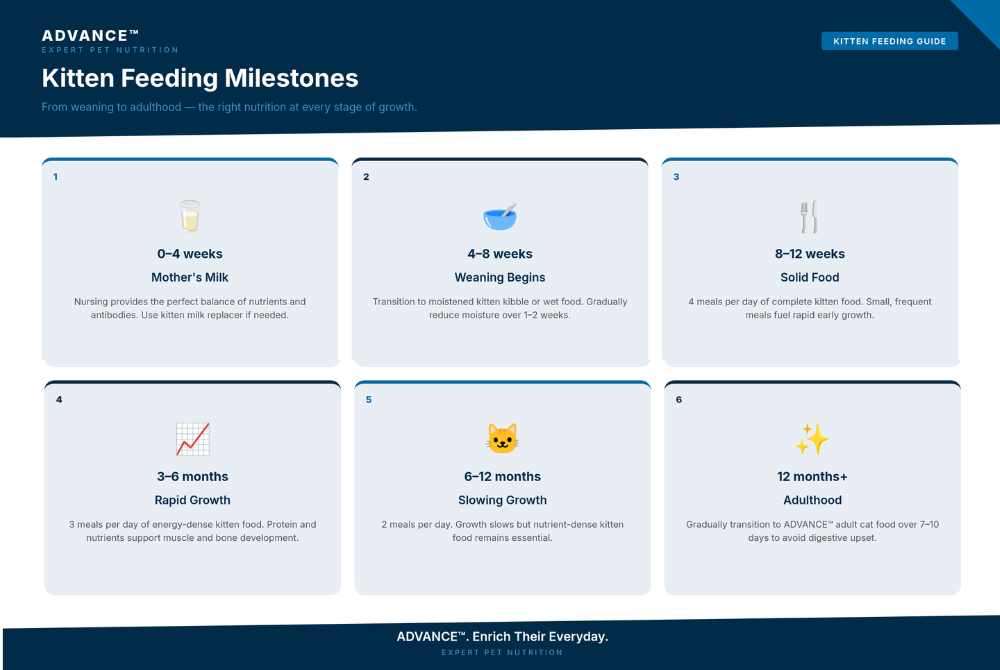
0–4 weeks: Mother's milk or milk replacer
In the first few weeks of life, kittens rely entirely on their mother's milk, which provides the perfect balance of nutrients and antibodies. If the mother is unavailable, a commercial kitten milk replacer is the best alternative — never use cow's milk, as it can cause digestive upset.
4–8 weeks: Weaning onto solid food
This is the transition stage. Start by offering moistened kitten kibble (soaked in warm water or kitten milk replacer) or a wet kitten food. Gradually reduce the moisture content over 1–2 weeks until your kitten is eating solid food comfortably. Small, frequent meals are essential at this stage.
8 weeks–6 months: Kitten growth food
This is the period of most rapid growth. Feed a complete, balanced kitten growth food — either dry, wet, or a combination — that's specifically formulated for kittens. These formulas are energy-dense and protein-rich to support muscle development, bone growth, and overall vitality.
Follow the feeding guide on the packaging and split the daily amount into 3–4 small meals.
6–12 months: Maintaining growth momentum
Growth begins to slow, but your kitten still needs the nutrient density of kitten food. Reduce to 2 meals per day and continue monitoring body condition. This is also a good time to start thinking about the transition to adult food, which typically happens around 12 months.
12 months+: Transition to adult food
Around 12 months of age, gradually transition your kitten to an ADVANCE™ adult cat diet over 7–10 days. Mix increasing amounts of the adult food with decreasing amounts of the kitten food to avoid digestive upset. Once fully transitioned, follow the adult feeding guide on the packaging.
Kitten feeding milestones from weaning to adulthood
Give your kitten the best start to life
Understanding your kitten's nutritional needs is one of the most powerful ways to set them up for a long, healthy life. But feeding is just one piece of the puzzle. For more expert guidance on raising a happy, healthy kitten — from weaning through to their first birthday — explore more of our kitten care advice.